Authored by: George King
R&D Manager & Emergency Preparedness Specialist at Fitiger Life LLC.
Medically Reviewed by Dr. Anish Desai
Board Certified Internal Medicine Physician
Updated on May 13, 2026 [SAN JOSE,CA]
|
What matters first School airway emergency policy in 2026 is no longer simply a device-purchase decision. It is a rapid-response systems issue: early recognition of severe choking, immediate EMS activation, age-appropriate first-line rescue maneuvers, and continuous supervision of the child while backup airway devices are retrieved. FDA-authorized suction airway devices may serve as adjunctive physical redundancy after unsuccessful guideline-based BLS choking interventions. Before choosing equipment, review Fitiger's anti-choking device buyer evidence checklist for FDA wording, testing, seller traceability, and kit-selection questions. |
Airway obstruction on campus is a delay problem before it is an equipment problem. The biology is unforgiving: once a student cannot cough, speak, cry, or breathe, the school is operating inside a shrinking oxygen window. Policy only helps when it compresses the time between recognition and useful action.
The 2026 policy environment is moving in that direction. New Jersey, Maryland, Georgia, and FDA activity are pushing schools and childcare systems toward a layered readiness model: prevention, first-line rescue, second-line backup, documented placement, trained personnel, and incident reporting that can survive review.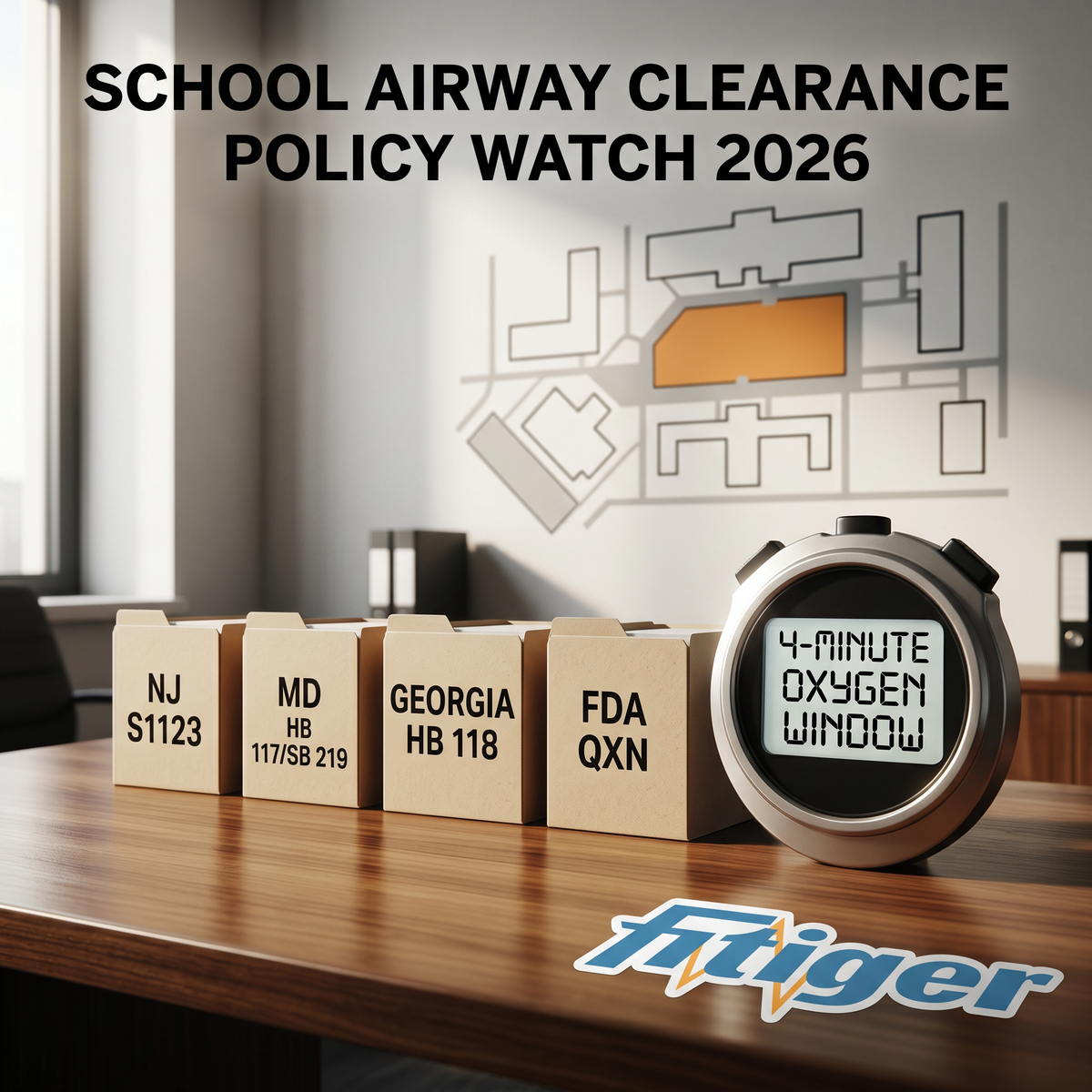
The wrong interpretation is simple: buy a device and call the campus safer. The safer interpretation is harder and more useful: prove the rescue path. Who recognizes severe choking? Who calls 911? Who starts age-correct first-line steps? Who retrieves backup without abandoning the child? Who records sequence latency after the event?
Key policy implications for schools and childcare systems
The current legislative pattern is not just about anti-choking devices. It is about whether campus leaders can show a complete airway response system before a cafeteria incident, field-trip meal, athletic event, or bus-route emergency exposes the gap.
New Jersey S1123 would require portable anti-choking devices to be placed in schools. Maryland HB 117 and SB 219, known as the Bowen Levy Airway Clearing Device Act, point toward at least one airway clearing device per public school, trained personnel authorization, and incident reporting. Georgia HB 118, discussed under the Jamal Bryant Jr. Act in the childcare context, expands the policy signal beyond K-12 into early childhood settings. Districts should verify bill status before treating any proposal as law.
The common thread is operational proof. Device availability, staff training, placement maps, reporting forms, and procurement files are becoming part of the same safety question.
|
Policy signal |
What it asks the system to prove |
School or childcare readiness implication |
|
Portable anti-choking devices in school settings, with policy and training expectations. |
Treat cafeteria, nurse office, and other eating areas as retrieval-time zones, not storage afterthoughts. |
|
|
County board policy, at least one airway clearing device per school, trained personnel authorization, and incident reporting. |
Build a documented policy file: first-line sequence, device-use boundary, incident form, parent notification, and reset procedure. |
|
|
Early childhood proposal linked to CPR timing and portable airway clearance device availability in childcare settings. |
Do not ignore childcare policy movement. Pre-K, after-care, and mixed-age campus programs need their own response radius and supervision plan. |
|
|
Established choking rescue protocols remain first-line; FDA-authorized anti-choking devices may be a second option if standard protocols are unsuccessful. |
Use FDA-authorized wording, verify 21 CFR 874.5400 / QXN / DEN250012, and remove vague registration claims from procurement files. |
|
|
Pediatric foreign body airway obstruction guidance updated for children and infants. |
Refresh child and infant choking training before adding device-specific drills. |
In pediatric choking emergencies, outcomes are determined less by the presence of a single device and more by whether the environment can recognize distress rapidly, mobilize trained responders immediately, and execute a coordinated airway rescue plan within minutes.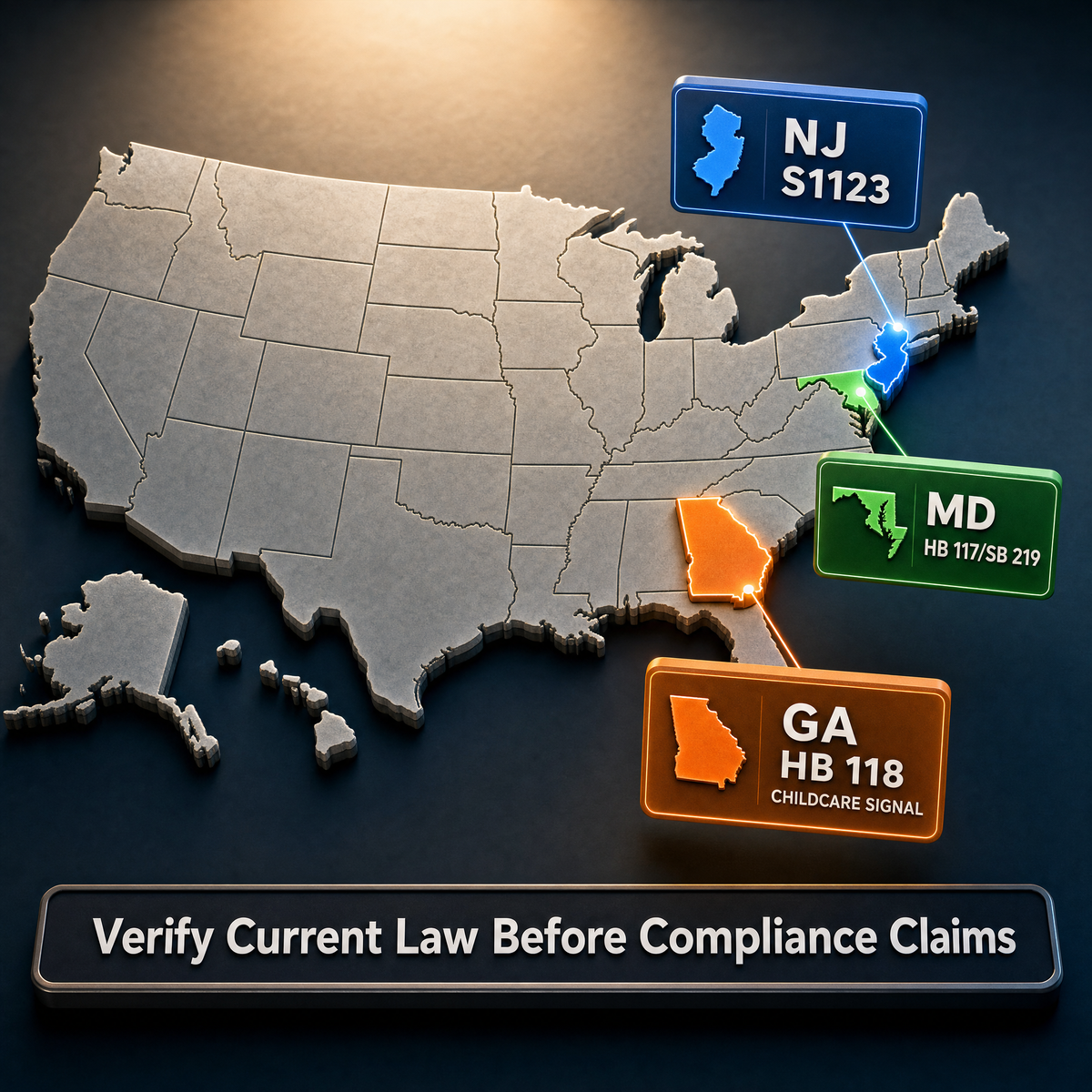
New Jersey S1123 is important because it ties portable anti-choking devices to the locations where choking risk concentrates. A hallway cabinet does not solve a lunchroom emergency if the retrieval route is long, blocked, or invisible under stress.
For school administrators, the practical test is not whether a device exists somewhere on campus. The test is whether a trained adult can reach backup equipment in seconds while another adult stays with the choking student and first-line care continues.
A compliant-looking plan can still fail in the cafeteria. Noise hides the first few seconds. Students stand up at once. Lunch carts block walls. Substitute monitors may not know where the nurse office is. Placement policy has to account for those conditions.
Maryland HB 117 and SB 219 are useful for schools outside Maryland because they show the architecture policymakers are starting to expect. Availability is one piece. Authorization, training, and reporting are the control system around it.
Standardized incident reporting converts clinical trauma into auditable safety data: location, bolus type, recognition time, 911 activation, first-line steps, device use if any, EMS handoff, parent notification, and corrective action.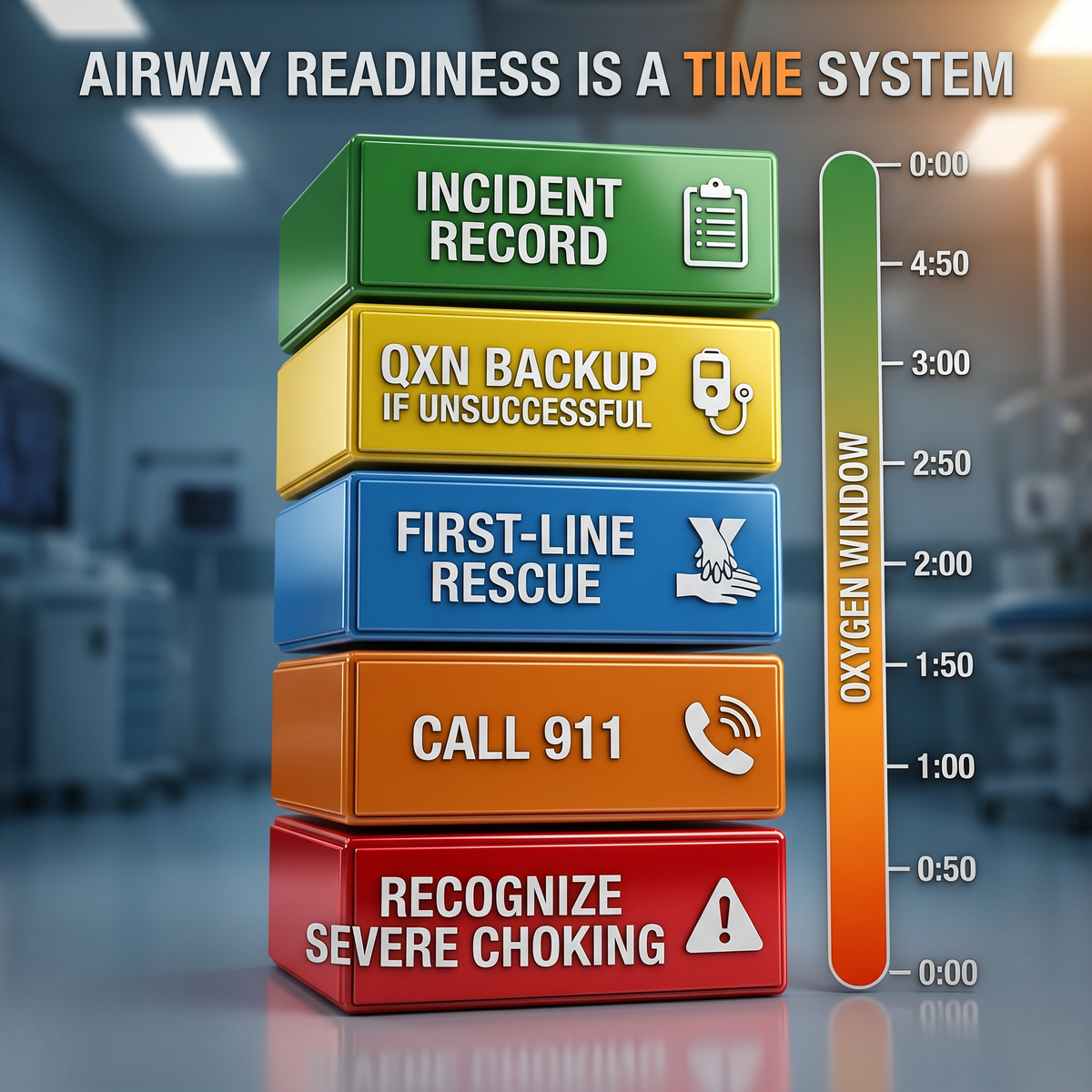
Without those fields, a district has anecdotes. With them, the district can identify patterns: a cafeteria corner with no line of sight, a bus route where students snack without adequate monitoring, or a staff group trained on an outdated sequence.
Georgia HB 118, often discussed in connection with the Jamal Bryant Jr. Act, belongs in a school policy watch even though its center of gravity is childcare. Many campuses operate pre-K programs, early learning partnerships, after-care rooms, and mixed-age meal settings. The same operational failure points appear there: small bodies, fast obstruction, distributed supervision, and delayed recognition.
Public reporting on the proposal described two pressure points: reducing the CPR certification window for new childcare employees from 90 days to 45 days, and requiring portable airway clearance devices in licensed childcare settings. The legislative status should be verified from current Georgia records before any compliance claim is made.
The useful lesson for K-12 teams is not to copy childcare language blindly. It is to watch how the policy vocabulary is changing: oxygen-window compression, trained personnel, device staging, and proof of action after the event.
Terminology is a safety control: "FDA-authorized" replaces the misleading "registered" tag in 2026 procurement files. Registration and listing are not the same as authorization, clearance, approval, or a granted De Novo classification.
The current regulatory identity schools should verify is specific: 21 CFR 874.5400, product code QXN, Class II, suction anti-choking device as a second-line treatment, DEN250012. The FDA definition places the device after unsuccessful basic life support choking protocol steps for complete airway obstruction.
A district file should reject language that suggests a suction device is first-line care. Established choking rescue protocols still come first. A QXN device can be staged as a physical redundancy layer only when staff know exactly where it sits in the response sequence.
Manual first-line rescue can fail for reasons that are not moral failures by the responder. The obstruction may be sticky, deformable, lodged at an angle, or difficult to move with the available pressure and geometry.
Food-texture research gives one useful engineering marker. In a tongue-palate compression simulator, clearing an example starch-based bolus required 5.4 kPa, compared with 1.7 kPa for a gum-based sample of equal apparent viscosity. The number is not a rescue-device performance threshold. It shows why foods with similar "thickness" can behave very differently when the airway or oral cavity has to be cleared.
School snacks often include starch-heavy foods: bread, crackers, chips, dense pastries, rice products, and compacted snack mixes. Policy should not assume every obstruction behaves like a smooth gel. A layered system is built for the possibility that first-line maneuvers do not clear the object fast enough.
|
Hazard or setting |
Physical or operational variable |
Policy response |
|
Starch-heavy foods |
Clearing pressure can be higher than for some gum-based materials; one simulator measured 5.4 kPa vs 1.7 kPa. |
Avoid oversized bites, rushing, food-stuffing challenges, and unsupervised high-density snack periods. |
|
Noisy cafeteria |
Severe choking may be silent; noise delays recognition and adult convergence. |
Line-of-sight coverage, short response radius, posted protocol, role drills. |
|
Special education or dysphagia risk |
Pediatric dysphagia studies report high silent aspiration rates among aspirating children; one large MBS cohort reported thin fluids silently aspirated in 81% of affected patients. |
Student-specific feeding plans, staff briefings, and a named response radius. |
|
School bus or field trip |
Narrow aisles, lone responder, delayed EMS access, limited equipment. |
Policy-defined supervision, secured in-cabin resources where allowed, route communication plan. |
Device policy cannot outrun first-aid training. For a conscious child with severe foreign body airway obstruction, the updated pediatric guidance supports repeated cycles of 5 back blows alternating with 5 abdominal thrusts. For infants, the sequence is 5 back blows alternating with 5 chest thrusts; abdominal thrusts are not recommended for infants because of injury risk.
A school that adds airway clearance devices without refreshing the age-correct sequence has built a fragile policy. The first action after recognition remains 911 activation and established first-line rescue. The device layer comes later, under a written boundary.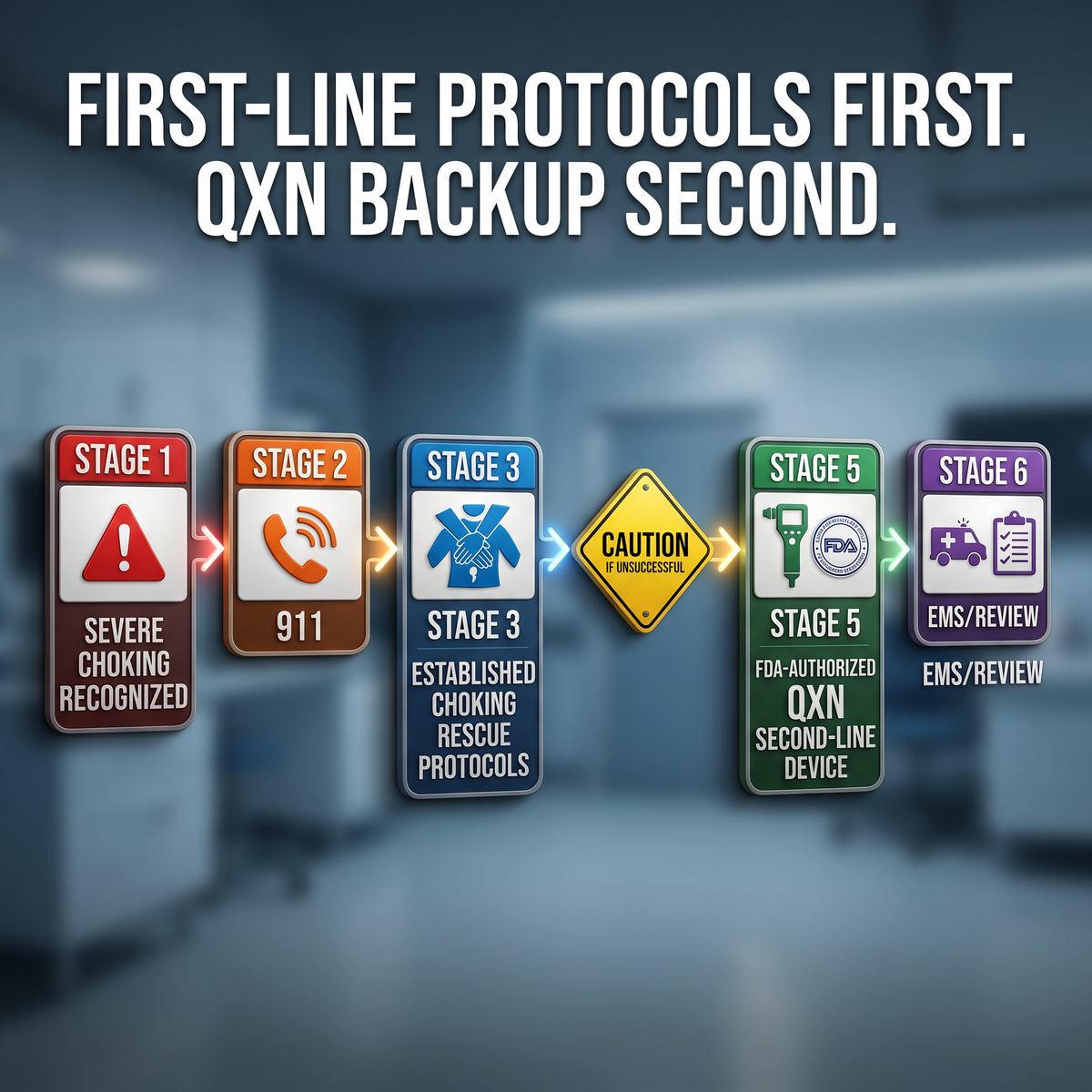
|
Response layer |
Campus responsibility |
Evidence to keep on file |
|
Reduce food, object, supervision, and layout hazards before lunch, clubs, bus routes, and after-care. |
Food modification rules, adult coverage map, student-specific feeding plans. |
|
|
Recognition |
Teach staff to separate mild choking from severe choking fast. Silence, inability to cough or speak, blue or gray color, panic, and declining alertness require immediate action. |
Training roster, poster locations, substitute briefing sheet. |
|
First-line rescue |
Call 911 and begin age-correct choking response immediately. |
AHA/AAP or Red Cross training records, drill notes, 911 role assignment. |
|
Second-line QXN device |
Use only as a defined backup after unsuccessful BLS choking protocol steps. |
FDA authorization record, IFU, placement map, trained-user list, replacement and inspection log. |
|
Post-incident review |
Turn the event into a corrective-action record. |
Incident form, EMS notes, parent notification, equipment reset, drill update. |
Placement should follow the physics of retrieval delay. A device locked in the nurse office may be useful for one hallway and too slow for a crowded cafeteria. A device near the cafeteria but hidden behind staff-only storage creates a different version of the same failure.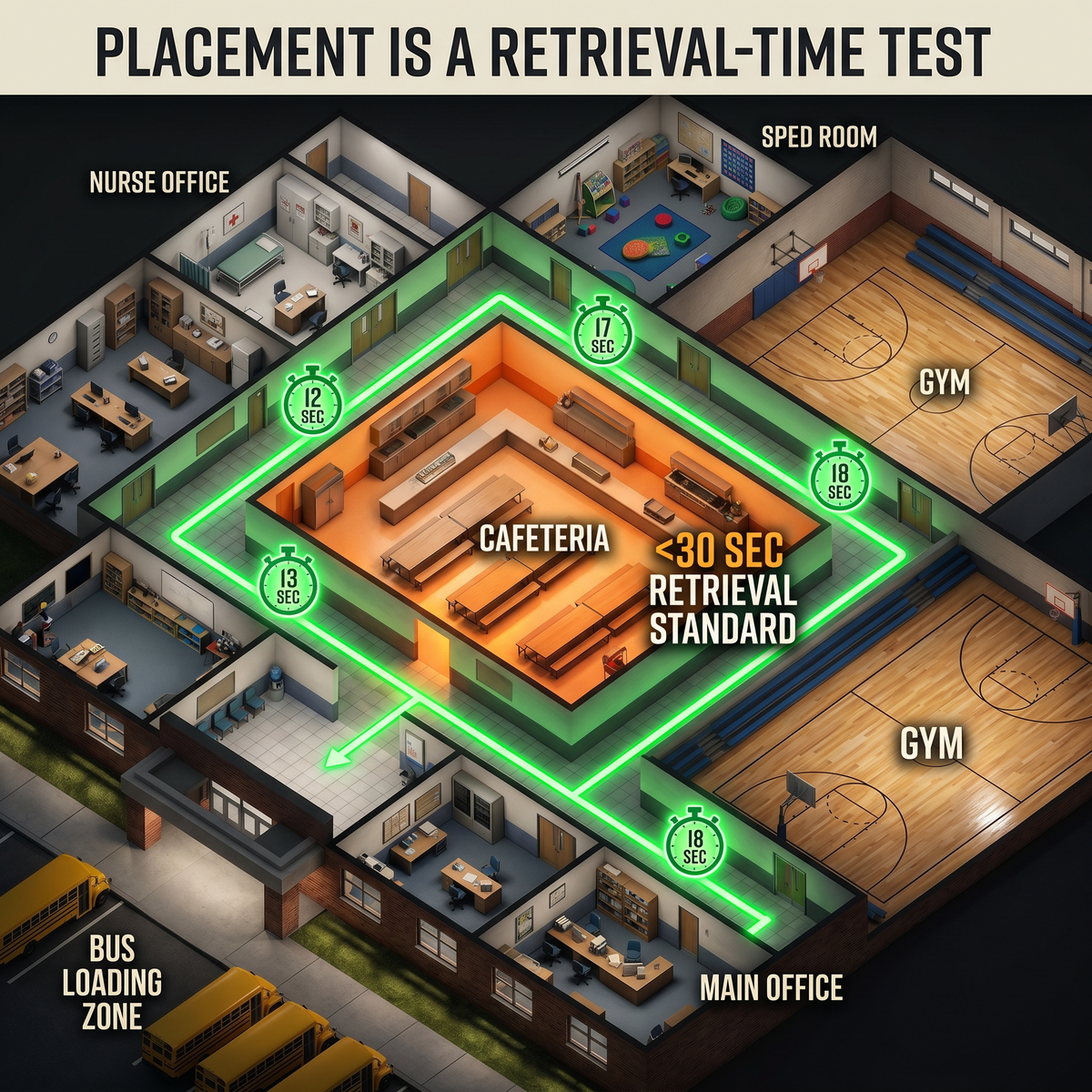
The audit question is simple: can a trained adult reach backup equipment in less than 30 seconds without leaving the choking student unsupported? If the answer depends on a key, one specific employee, or a distant office, the plan is brittle.
|
Campus zone |
Risk variable |
Engineering placement standard |
|
Highest noise and density; food exposure concentrates here. |
Retrieval path under 30 seconds, visible to lunch staff, not blocked by carts or locked storage. |
|
|
Nurse office |
Logistics base, inventory control, health documentation. |
Staging must not require keys or single-person availability; do not treat it as the only active location. |
|
Special education / SPED rooms |
Silent aspiration and feeding-plan complexity can raise recognition burden. |
Student-specific "response radius" tied to staff coverage, diet plan, and trained personnel. |
|
Main office |
EMS coordination and visitor access. |
Defined as backup storage or active deployment point; front-desk staff know call and routing roles. |
|
Food events, sports snacks, assemblies, and low medical visibility. |
Visible during events, not buried behind equipment storage. |
|
|
Lone responder, narrow aisles, delayed EMS access, communication lag. |
Staged in-cabin where policy permits, secured against misuse yet accessible to trained adults. |
Most school plans over-focus on the adult performing the maneuver. Airway response is a team sequence. One adult starts first-line care. One calls 911 and stays on the line. One retrieves the AED and backup equipment. One clears students away. One meets EMS. One records time points after the event.
Short drills expose failures that annual lectures miss: the cafeteria door that locks from the wrong side, the intercom dead zone, the cabinet blocked by lunch carts, the bus driver who does not know whether students are allowed to snack, or the substitute monitor who assumes someone else called 911.
A usable drill record should capture four timestamps: recognition, 911 activation, first maneuver, and backup equipment arrival. Those numbers tell a district whether the policy works under cafeteria conditions.
A school procurement file should be specific enough for a nurse, purchasing officer, legal reviewer, and safety lead to reach the same conclusion. The file should include the device name, manufacturer, FDA authorization record when applicable, labeling, IFU, training materials, storage conditions, cleaning or single-use status, replacement schedule, incident form, and local policy language.
Reject vague claims: "FDA registered," "doctor recommended," "used by thousands," or "approved by schools." For this category, the file should trace back to FDA records or official documentation. The safer language is narrow and verifiable: FDA-authorized QXN suction anti-choking device as a second-line treatment, used after unsuccessful BLS choking protocol steps.
| Procurement field | What to verify | Unsafe shortcut to reject |
| Regulatory status | FDA authorization, regulation number 874.5400, product code QXN, De Novo or database record. | "FDA registered" used as if it means authorized. |
| Use boundary | Second-line after unsuccessful BLS choking protocol steps. | Language implying the device replaces first-line rescue. |
| Training material | IFU, staff module, drill sequence, refresher schedule. | A device box placed without a training file. |
| Placement file | Campus map, retrieval-time test, responsible staff role. | One device locked in a distant office. |
| Incident report | Location, bolus, timings, first-line care, device use if any, EMS, parent notification, review. | No standardized form after a severe choking event. |
A choking event should not be reviewed as a single-person performance test. Failure to Rescue starts earlier: a compressed lunch period, unmanaged food hazards, no assigned caller, equipment staged outside the eating area, staff trained on an outdated sequence, or a procurement file that never defines second-line use.
The stronger school policy assumes imperfect conditions. Students panic. Noise hides weak breathing. Staff hesitate when roles are vague. A device may be too far away. EMS may need a building escort. The design job is to remove those failure points before the emergency.
Fitiger supports schools with readiness planning, placement reviews, checklist design, and documentation support. The product layer is only one part of the system. The harder work is building a response pathway that reduces hesitation before the emergency happens.
Start with a room-by-room airway readiness audit. Mark the cafeteria, serving line, gym, nurse office, main office, SPED rooms, transportation loading areas, after-care spaces, and field-trip staging points. Identify who supervises food in each zone and whether that person has current choking response training.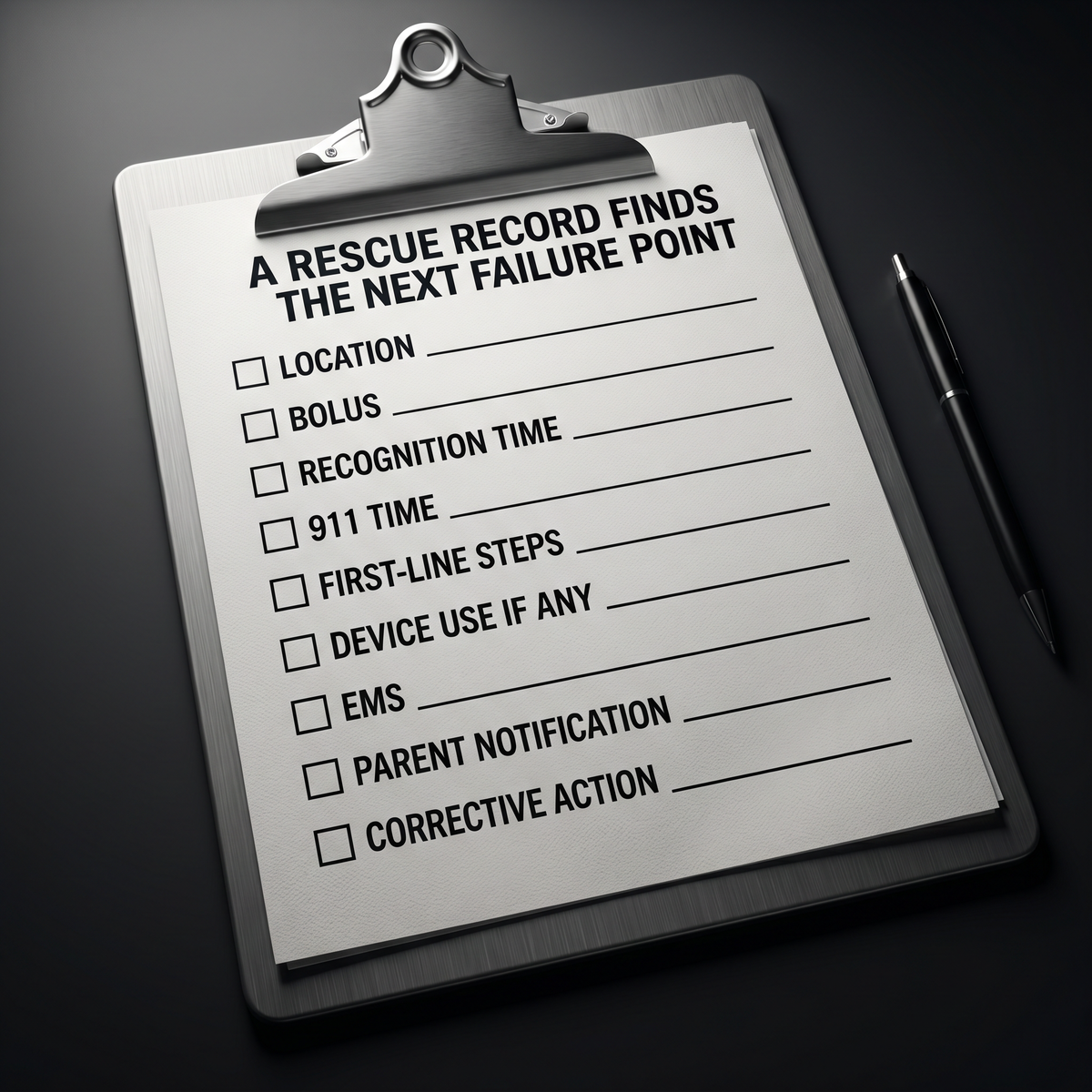
Build a one-page policy draft that names first-line response, 911 activation, backup equipment retrieval, QXN device-use boundaries, incident reporting, parent notification, and post-event review. Keep it short enough for a lunchroom monitor to use under stress.
Run one drill in the cafeteria before procurement is finalized. If the drill cannot produce a clean call-retrieve-handoff sequence, the district has a design problem, not a purchasing problem.
|
Task |
Minimum evidence |
|
Verify state law and active bills |
Bill status printout, legal review note, or district policy memo dated for the current school year. |
|
Update choking rescue training |
Roster showing staff trained on child and infant 2025 AHA/AAP or equivalent sequence where relevant. |
|
Map eating and gathering zones |
Placement map with retrieval route, response radius, and named staff role. |
|
Verify device regulatory status |
FDA database record, IFU, labeling, training materials, and purchasing file. |
|
Run role-based drills |
Drill date, participants, recognition-to-call time, time-to-retrieve, handoff quality, corrective actions. |
|
Prepare incident reporting |
One-page form covering first-line care, second-line device use if any, EMS, parent notification, and review. |
FITIGER note
FITIGER supports emergency preparedness planning and training resources for schools, including placement guidance, checklists, and documentation support through our Schools Program.
Are airway-clearing devices required in all U.S. schools in 2026?
No. Requirements vary by state and can change during a legislative session. New Jersey and Maryland proposals point toward device placement and policy requirements, but schools should verify current law, bill status, and district policy before making any compliance claim.
Should a school use an anti-choking device before back blows or abdominal thrusts?
No. FDA safety communication says established choking rescue protocols remain first-line. An FDA-authorized QXN suction anti-choking device is a second-line option after unsuccessful basic life support choking protocol steps.
What does QXN mean in school procurement?
QXN is the FDA product code for suction anti-choking devices as a second-line treatment under 21 CFR 874.5400. Procurement files should verify FDA authorization instead of relying on registration, marketing claims, or general testimonials.
Why does the cafeteria need its own placement test?
The cafeteria has the highest food exposure, noise, density, and line-of-sight burden. A device stored in the nurse office may not be fast enough for a lunchroom rescue unless the retrieval route and staffing pattern prove it.
What should a school document after any severe choking incident?
Document location, time recognized, choking signs, food or object involved, 911 activation time, first-line maneuvers, device use if any, EMS transfer, parent notification, witnesses, and post-incident corrective actions.
New Jersey Legislature - S1123 bill text and status
New Jersey Senate Republican Office - S1123 committee update
Maryland General Assembly - HB0117 final PDF
Maryland General Assembly - SB0219 details
Georgia General Assembly - HB 118 bill document
The Current GA - House bill proposed after child dies at daycare
FDA Safety Communication - Established Choking Rescue Protocols
FDA De Novo Database - DEN250012
FDA TPLC Database - Product Code QXN
American Heart Association Newsroom - 2025 CPR guideline updates
HealthyChildren.org / AAP - Pediatric CPR guideline update
Redfearn et al. - Tongue-palate compression simulator
Velayutham et al. - Silent aspiration, who is at risk?
This article is for emergency preparedness planning and training support. It is not medical advice, legal advice, diagnosis, or treatment. Follow your school policies, local regulations, emergency protocols, and current training from qualified CPR and first-aid organizations. Verify legislative status and FDA authorization records before making procurement or compliance decisions.


